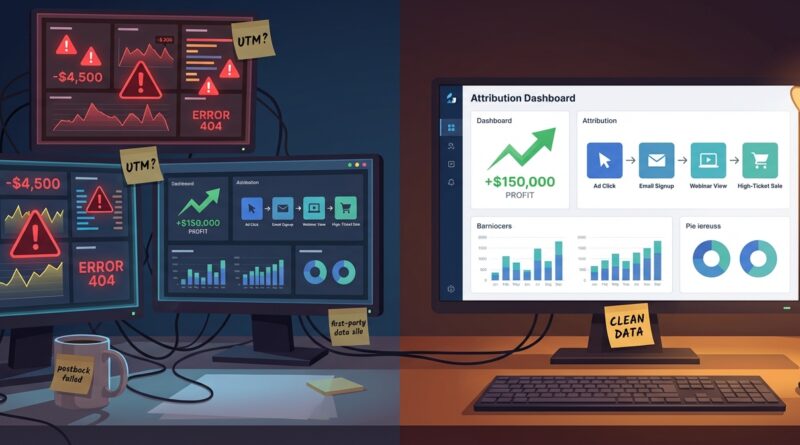
The Silent Killer of High-Ticket Affiliate Profits: Broken Attribution (And How One Brand Fixed It)
You know the feeling. The clicks are coming in, your content is solid, your ads are spending money, and people are clearly interested. But your affiliate dashboard looks dead. That is enough to make any high-ticket affiliate question everything. The offer. The funnel. The traffic source. Even yourself. The ugly truth is that a lot of the time, the problem is not poor marketing. It is broken attribution. A buyer sees your review on mobile, comes back later on a laptop, clicks a retargeting ad, then buys through a path your affiliate platform barely understands. Now the sale gets credited somewhere else, or nowhere at all. When commissions are worth hundreds or even thousands, that kind of tracking mess is not a small bug. It is a profit killer. Here is a practical high ticket affiliate marketing attribution case study that shows what was going wrong, what got fixed, and what you can copy.
⚡ In a Hurry? Key Takeaways
- Broken attribution can make winning campaigns look unprofitable, especially in high-ticket affiliate offers with long and messy buyer journeys.
- Start by matching first-party lead events, click IDs, and affiliate dashboard sales into one simple reporting sheet before you spend more on ads.
- You do not need perfect tracking to improve results, but you do need a cleaner source of truth so AI ad platforms are not optimizing on bad signals.
The real problem was not traffic
A brand in the high-ticket education space came in with a complaint I hear all the time. “Meta says one thing. Google says another. The affiliate platform barely shows sales. We know people are buying, but we cannot tell what is actually driving revenue.”
They were running paid traffic, organic content, email follow-up, and creator partnerships. On paper, it looked healthy. Cost per lead was acceptable. Click-through rates were decent. Sales calls were happening. But affiliate commissions reported to partners were inconsistent, late, or missing.
That created three big problems.
1. Good content was getting paused
Top-of-funnel videos and reviews were sending buyers into the system, but because the final sale often happened days later on another device, those pieces looked weak.
2. Ad platforms were learning from the wrong signals
Instead of optimizing for qualified leads or closed sales, the platforms were chasing cheap clicks and soft conversions. That is how budgets drift into junk traffic.
3. Affiliates lost trust
Nothing sours a relationship faster than a partner believing they created demand but did not get paid for it.
If that sounds familiar, you are not alone. It is a close cousin to the chaos many creators feel on social commerce channels too. If you are juggling inconsistent performance there as well, this piece on The best way to turn TikTok Shop chaos into consistent high-ticket affiliate income is worth your time.
What was actually broken
Once we mapped the funnel, the gaps were obvious.
Last-click reporting was hiding the full journey
A typical buyer path looked like this. First, they watched a YouTube review or clicked a blog post. Then they joined an email list from their phone. Two days later they searched the brand name on Google from a desktop computer. Then they clicked a branded ad, booked a call, and purchased after a sales rep follow-up.
Who gets credit in that chain? Depending on the platform, the answer was “Google,” “direct,” “unknown,” or nobody.
Affiliate links were being dropped too early
Some traffic landed on pre-sell pages that did not reliably store source data. In other cases, redirects stripped tracking parameters. A few affiliate cookies expired before the buyer was ready to act.
CRM and affiliate data were living in separate worlds
The sales team could see who bought. The affiliate platform could see some clicks. The ad platforms could see lead forms. But nobody had one joined-up record that tied the original content touchpoint to the final sale.
Offline conversions were not being sent back to ad platforms
This is a big one. If your best signal happens in a CRM after a call closes, and you never send that result back to Meta or Google, their systems cannot learn who your real buyers are.
How the brand fixed it
The good news is they did not need some magical enterprise stack. They needed a cleaner process and a simple measurement framework.
Step 1: They created one source-of-truth ID
Every lead got a unique first-party identifier as soon as they entered the funnel. That ID was stored in the CRM and passed through form fills, booking steps, email records, and purchase data wherever possible.
This matters because names and emails change. People use work emails, personal emails, and different devices. A stable ID gives you something to tie the journey together with.
Step 2: They captured click data early
UTM parameters, ad click IDs, landing page source, and referring content were stored the moment a visitor arrived. Not later. Not only after purchase. Right at the top.
They also stopped relying on affiliate platform cookies alone. Those still had value, but they were no longer treated as the only record that mattered.
Step 3: They mapped touchpoints into simple buckets
Instead of arguing over perfect attribution models, they used a practical one. Every closed sale was tagged across three layers:
- First touch. Where the relationship started.
- Lead touch. What drove the opt-in or booked call.
- Close touch. What happened nearest the sale.
That gave them a more honest view. Content often won first touch. Retargeting often won lead touch. Brand search often won close touch. All three played a role.
Step 4: They sent qualified events back to ad platforms
Not every lead is useful. So they pushed better signals back into Meta and Google, such as booked calls, attended calls, and closed sales when possible. This gave the algorithms cleaner training data.
That one move alone improved media efficiency within a few weeks because the platforms finally had a better idea of what a real buyer looked like.
Step 5: They built a weekly reconciliation report
This was not fancy. It was a disciplined spreadsheet and dashboard routine. Each week they compared:
- Ad platform reported leads
- CRM leads and booked calls
- Affiliate clicks and attributed sales
- Actual closed revenue
Any mismatch over a set threshold got reviewed. That stopped silent data loss from piling up for months.
The before-and-after result
Before the cleanup, the brand was close to shutting off certain content partnerships and cutting ad spend on campaigns that looked weak in-platform.
After 60 days of better attribution, the picture changed.
What they discovered
- Several “unprofitable” creator placements were actually generating high-value first touches that closed later through email and sales calls.
- Branded search was over-credited because it sat near the end of the funnel.
- Retargeting ads were useful, but not as heroic as they appeared in last-click reports.
- One long-form review page was quietly influencing more closed sales than any short-form ad creative.
What changed in the numbers
The brand reallocated spend toward assets that started high-quality buyer journeys. They also improved commission confidence with partners because they could explain where sales were coming from more clearly.
Over the next quarter, reported return on ad spend improved, but the more important win was this: wasted spend dropped. Campaigns were judged on cleaner data, not on half-blind platform claims.
What high-ticket affiliates can copy today
You do not need to rebuild your whole business this week. Start with the pieces that create the biggest clarity fastest.
Use first-party tracking wherever you can
If a visitor hits your landing page, capture source details immediately. Store UTMs, click IDs, timestamp, landing page, and referring content. Keep that data tied to the lead inside your CRM or database.
Stop trusting one dashboard
Your affiliate platform is not the full truth. Neither is Meta. Neither is Google. Treat each one like a witness, not the judge.
Track milestones, not just sales
For high-ticket offers, there is usually a long gap between click and commission. So measure intermediate steps that signal quality. Think booked calls, webinar attendance, application completion, and sales-qualified leads.
Review attribution by content and by creative
Do not only ask which channel drove sales. Ask which specific review, video angle, email, or ad hook introduced the buyer. That is where your next gains often sit.
Expect some mess
Privacy changes, browser restrictions, and multi-device behavior mean perfect attribution is gone for most marketers. The goal is not perfection. It is useful truth.
Common mistakes that keep profits hidden
Paying to scale before measurement is stable
If you are increasing budget while your data is full of holes, you are just buying more confusion.
Using only default attribution windows
High-ticket products often need more time. A seven-day click window may miss a lot of reality. Compare platform windows against your actual sales cycle.
Ignoring CRM data
If the sale closes offline or through a rep, the CRM is not optional. It is central.
Failing to document redirects and handoffs
Every extra hop can strip parameters or break cookies. Test your links often. Click them like a customer would.
A simple attribution stack for non-technical teams
If you want a practical setup, here is a sane starting point:
- Landing pages that store UTMs and click IDs on first visit
- A CRM that keeps a unique lead ID and purchase status
- Affiliate links and sub-IDs for partner-level tracking
- Weekly export or dashboard combining ad spend, leads, calls, and closed sales
- Offline conversion uploads or API event sharing back to ad platforms
You can build from there. The point is to connect the journey enough that you can make better decisions.
At a Glance: Comparison
| Feature/Aspect | Details | Verdict |
|---|---|---|
| Last-click platform reporting | Easy to read, but it often over-credits the final touch and hides content that started the sale. | Useful for a quick check, not enough for high-ticket decisions. |
| First-party + CRM-based tracking | Captures lead source, milestones, and closed sales across longer buying cycles and multiple devices. | Best foundation for cleaner attribution. |
| Affiliate dashboard alone | Helpful for commission records, but often blind to earlier touchpoints and offline closes. | Good as one input, dangerous as the only source of truth. |
Conclusion
Broken attribution is one of the quietest ways to lose money in affiliate marketing, and high-ticket affiliates feel it the most because every missed sale hurts. Privacy changes, multi-device journeys, and AI ad systems trained on noisy signals have made the problem worse, not better. But this is fixable. You do not need perfect data. You need cleaner data that joins ad platform reporting, affiliate dashboards, and first-party events closely enough to show what is truly working. That lets you stop cutting winners, stop feeding losers, and finally see which channels, content, and creatives are driving real commissions. If your dashboard has been telling a confusing story, take that as a sign to investigate, not to give up. The money might already be there. You just need tracking honest enough to find it.