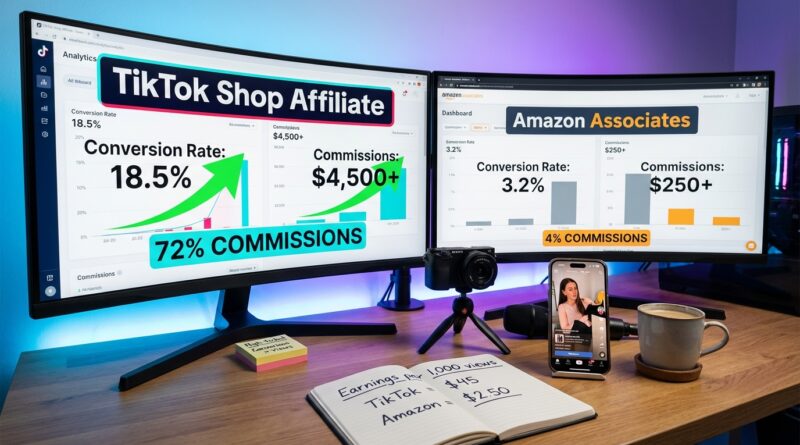
TikTok Shop Affiliate vs Amazon Associates: The Real 2026 Payout Gap For High‑Ticket Creators
You can do everything “right” as an affiliate creator and still feel like the math is broken. You post the review. You answer comments. You make the comparison video. Then the payout lands and it looks weirdly small for the amount of work you put in. That frustration is real, especially if you are promoting higher-priced products and expecting bigger commissions to match. The hard truth for 2026 is that TikTok Shop and Amazon Associates are no longer close competitors for many high-ticket creators. They are built around different buying habits, different commission systems, and very different conversion paths. If your goal is effective earnings per 1,000 views, not just “having links out there,” the gap matters. A lot. For many creators, Amazon is still the familiar default. But familiar does not always mean best-paying, and that is where this comparison gets interesting.
⚡ In a Hurry? Key Takeaways
- TikTok Shop often beats Amazon Associates for high-ticket creators in 2026 because commissions are usually higher and checkout friction is lower.
- Run the same product angle on both platforms for 30 days and compare earnings per 1,000 views, not just clicks or total sales.
- Amazon is still useful for trust and broad catalog coverage, but many creators leave money on the table if they treat it as their only affiliate option.
The real question is not “Which program is bigger?”
The real question is, “Which one pays you more for the same attention?”
That is the mistake a lot of creators make. They compare Amazon and TikTok Shop by brand recognition, product count, or what other people are doing. None of those things pay your bills.
If you are focused on high-ticket products, you need three numbers:
- Average commission rate
- Conversion rate from content to sale
- Earnings per 1,000 views
That last one matters most because it tells you whether your content is actually working as a business.
Why TikTok Shop is pulling ahead
1. The buying journey is shorter
TikTok Shop keeps the buyer close to the content. Someone sees the product, hears your pitch, checks social proof, and can often buy without leaving the app.
That sounds simple, but it changes everything.
On Amazon Associates, your viewer usually leaves your content, lands on Amazon, gets distracted by competing products, reads a dozen reviews, and may buy something else entirely. Sometimes you still get credit. Sometimes you do not. For high-ticket products, that extra hesitation can kill conversions.
2. Commission flexibility is better
Amazon Associates usually gives you fixed category-based rates. Those rates are easy to understand, but they are often not exciting for high-ticket creators. Selling a $500 or $1,000 item sounds great until you realize the category commission is modest.
TikTok Shop can be much more aggressive. Brands frequently set creator commissions that are designed to move inventory fast. That means you may see offers in the 10 percent to 20 percent range, sometimes more during campaigns, compared with Amazon categories that can land much lower.
Not every TikTok Shop offer is amazing, of course. Some are weak. But the ceiling is clearly higher.
3. Social proof does more of the selling
Amazon relies heavily on product pages and buyer intent. TikTok relies on momentum. If your video gets traction, comments stack up, creator clips appear, and viewers feel like they are seeing a product people actually use.
For high-ticket items, that social proof can reduce the “Do I really need this?” pause.
What the payout gap can look like in real life
Let’s use a simple example. Say you create content around a $400 desk setup product, a premium kitchen device, or a home fitness machine.
Scenario A: Amazon Associates
- Product price: $400
- Commission rate: 3 percent
- Commission per sale: $12
- Views: 100,000
- Click-through rate: 2 percent
- Clicks: 2,000
- Conversion rate on Amazon: 3 percent
- Sales: 60
- Total commission: $720
- Earnings per 1,000 views: $7.20
Scenario B: TikTok Shop Affiliate
- Product price: $400
- Commission rate: 12 percent
- Commission per sale: $48
- Views: 100,000
- Engaged click or purchase flow is more native
- Effective conversion from interested viewers: stronger due to in-app checkout
- Sales: even 40 sales would mean $1,920 total commission
- Earnings per 1,000 views: $19.20
That is not a small difference. That is a business model difference.
Even if TikTok Shop converts at a similar or slightly lower sales volume, the higher commission can still create a much bigger payout. And if both commission and conversion improve, the gap widens fast.
Why high-ticket creators feel this gap more than everyone else
If you are promoting lower-priced impulse buys, a weak commission can be masked by volume. Sell enough $20 gadgets and the totals can still look fine.
High-ticket products are less forgiving.
You usually get:
- Fewer total buyers
- More questions before purchase
- Longer consideration time
- Higher expectations from your audience
That means every extra bit of friction hurts more. A weak platform structure is not just annoying. It directly cuts your income.
When the item costs hundreds of dollars, the creator needs either a strong commission, strong conversion, or ideally both. TikTok Shop is increasingly offering both. Amazon often offers only one, and sometimes neither.
Where Amazon Associates still makes sense
Broad product coverage
Amazon still wins on catalog size. If you cover niche tools, specialty accessories, replacement parts, or product categories that are not active on TikTok Shop, Amazon gives you reach TikTok cannot match.
Built-in shopper trust
Many people trust Amazon checkout, shipping, returns, and customer support. For some audiences, especially older buyers, that matters a lot.
Longer-tail search traffic
Amazon can still pair well with blog posts, YouTube reviews, and search-driven content. If your content is less about impulse and more about detailed research, Amazon may still convert steadily over time.
So no, Amazon is not dead. It is just no longer the automatic best answer for creators chasing the biggest payout on expensive products.
Where TikTok Shop can disappoint
Not every brand is quality
Some products are great. Some are overhyped. If you push weak products just because the commission is high, your audience will remember.
Program changes happen fast
TikTok moves quickly. Commission rates, creator incentives, category focus, and campaign terms can change with little warning. You need to check the current offer, not rely on what worked three months ago.
It depends on content fit
TikTok Shop shines when the product is easy to show, easy to understand, and easy to want. Some high-ticket items need more explanation than a short social video can give. In those cases, Amazon plus a strong review article or long-form video can still be the better route.
How to compare them the smart way
If you want a real answer for your niche, stop arguing in theory and test both.
Track these four numbers
- Views
- Clicks or product page opens
- Sales
- Total commission
Then calculate:
- Conversion rate
- Average commission per sale
- Earnings per 1,000 views
This is where creators often surprise themselves. The platform with fewer total sales can still be the better money-maker if the commission is dramatically higher.
Use the same content angle
Do not compare a polished TikTok Shop winner to a lazy Amazon link dropped in your bio. That is not a fair test.
Use the same product story, same audience pain point, and same level of effort. Then look at the results after a meaningful sample size.
Give it 30 days minimum
One viral post can distort everything. Give each platform enough time to show a pattern.
A practical 2026 playbook for high-ticket creators
If I were advising a creator starting fresh today, I would keep it simple.
Start with TikTok Shop if the product is available there
If the product has a solid commission, decent reviews, and a format that works well in short video, start there first. The upside is too big to ignore.
Keep Amazon as your backup and bridge
Use Amazon when:
- The brand is not on TikTok Shop
- Your audience prefers Amazon
- You are creating search-based content outside TikTok
- You need a trusted fallback option
Do not chase commission at the expense of trust
This is the part too many people skip. A high payout is great, but one bad recommendation can damage months of credibility. For high-ticket products, trust is the real asset. Protect it.
The hidden metric most creators miss
Creators talk a lot about revenue. They should talk more about effort-adjusted revenue.
If Amazon and TikTok Shop both require the same number of videos, the same comment replies, and the same editing time, but one pays double per 1,000 views, the winner is obvious.
This is why the tiktok shop affiliate vs amazon associates high ticket debate matters right now. It is not about trends. It is about not doing the same amount of work for half the money.
At a Glance: Comparison
| Feature/Aspect | Details | Verdict |
|---|---|---|
| Commission rates | Amazon usually has fixed category rates that can feel low for expensive products. TikTok Shop often offers higher brand-set commissions and promo boosts. | TikTok Shop wins for payout potential. |
| Conversion path | Amazon sends users into a busy marketplace with more comparison shopping. TikTok Shop keeps buying closer to the content and inside the app. | TikTok Shop usually wins for lower friction. |
| Best use case | Amazon works well for broad catalogs, trusted checkout, and search-based content. TikTok Shop works best for social-first, demo-driven, high-intent video selling. | Use TikTok Shop first when available, keep Amazon as a secondary channel. |
Conclusion
If you are serious about affiliate income from expensive products, 2026 is a good time to stop running on autopilot. Amazon Associates still has a place, but for many creators it is no longer the strongest default. TikTok Shop is quietly beating it in the areas that matter most for high-ticket promotions, higher commission flexibility, smoother buying flow, and stronger earnings per 1,000 views. The smart move is not blind loyalty to either platform. It is testing with real numbers, keeping your audience’s trust, and putting your effort where the return is best. Creators are finally seeing that the old Amazon-only playbook does not always hold up anymore. Once you compare the math honestly, the better path often becomes pretty clear.