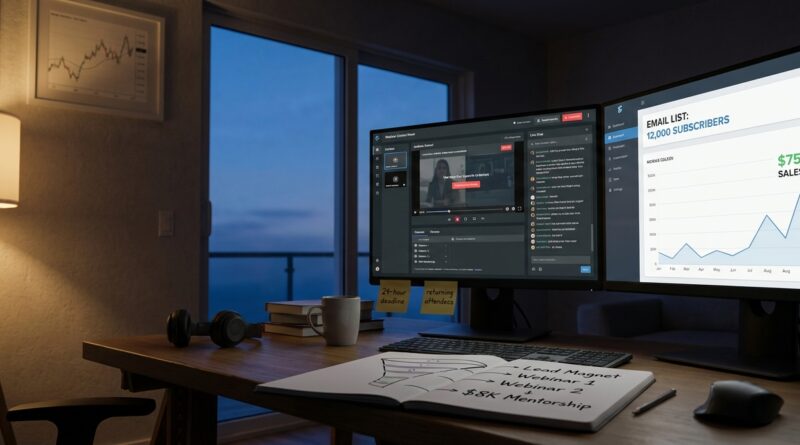
The ‘Two‑Webinar Ladder’: How One Tiny Email List Turned $12K Leads Into $75K High‑Ticket Sales
It is frustrating to put all your hope into one webinar, watch a few people show up, and then hear the usual line that high-ticket offers only work if you have a huge audience. That is usually not the real problem. More often, the webinar did too much, too soon, for people who were interested but not ready. This high ticket affiliate webinar funnel case study shows what happened when a small email list stopped treating the webinar like a one-night performance and started using it like a simple ladder. The first webinar warmed people up. The second moved serious prospects into private conversations. The result was $12,000 in front-end leads turning into $75,000 in high-ticket sales, including an $8,000 mentorship back-end. No giant list. No miracle ad spend. Just better timing, cleaner segmentation, and a follow-up sequence built for hesitant buyers instead of impulse clicks.
⚡ In a Hurry? Key Takeaways
- A small list can sell high-ticket offers if you use two webinars instead of asking one event to do everything.
- Segment attendees by behavior, then send different emails to watchers, no-shows, and clickers within 24 to 72 hours.
- The goal is not to pressure cold leads. It is to warm them in public, then move the right people into private sales calls.
Why one webinar usually falls flat
Most affiliates run a webinar like a launch party. They drive traffic, send reminders, pitch hard, and hope enough people buy before the replay expires.
That can work for lower-priced products. It often breaks down with high-ticket offers.
Why? Because an expensive offer asks for more trust. People need to believe in the method, the mentor, and their own ability to follow through. One hour on Zoom rarely fixes all three.
So when affiliates say high-ticket is too hard, what they often mean is this. They used a one-step process for a two-step decision.
The simple fix: a two-webinar ladder
The smarter setup is a ladder.
Webinar one does the heavy lifting in public. It teaches, handles objections, and shows what is possible. Webinar two is smaller and more focused. It is for people who raised their hand but did not buy yet.
That second event is where the money often shows up.
Step 1: Use the first webinar to sort, not just sell
The first webinar should not try to close everyone. It should sort people into buckets.
For example:
- People who registered but did not attend
- People who attended but left early
- People who stayed to the pitch
- People who clicked to learn more
- People who booked a call
That is where many affiliates miss easy money. They send the same replay email to all five groups, then wonder why conversions stay low.
A person who watched 50 minutes is not the same as a person who forgot the event even existed. Their next email should not be the same either.
Step 2: Use the second webinar to answer “maybe”
The second webinar is not a repeat in the lazy sense. It is a second touch with a tighter job.
Think of it like this:
- Webinar one says, “Here is the opportunity.”
- Webinar two says, “Here is why this is safe, realistic, and right for you.”
That means more case studies. More common objections. More talk about implementation. Less broad teaching. More decision support.
This is especially useful for high-ticket affiliate offers because buyers are usually not confused about the price. They are confused about the risk.
The case study: how $12K in leads turned into $75K in sales
Here is the core story.
A small, segmented email list was used to promote a front-end workshop that fed into a higher-ticket offer. The first product was affordable enough to get people moving. The back-end was an $8,000 mentorship.
Instead of asking cold traffic to jump straight to the premium offer, the campaign used a ladder:
- A lower-friction entry point
- A value-driven first webinar
- Behavior-based follow-up emails
- A second webinar for warm non-buyers
- Private calls for the most interested people
That sequence turned roughly $12,000 worth of lead activity and front-end buyer momentum into $75,000 in high-ticket sales.
The key point is not the exact numbers. It is the structure. The list was not massive. The system simply gave interested people more than one chance to buy.
What made the funnel work
A product ladder instead of a giant jump
People rarely go from stranger to $8,000 buyer in one clean move. Some do, but most need a smaller commitment first.
That smaller step can be a workshop, challenge, mini-course, or low-ticket training. It works because it changes the relationship. The lead is no longer just curious. They have now acted.
That matters.
If you have been following the wider shift toward more thoughtful premium funnels, The New High‑Ticket Funnel Nobody Is Talking About: Turning Tiny ClickBank Case Studies Into $1K Buyers makes a similar point. Smaller proof points often beat bigger promises.
Email timing did more work than the pitch
This is where non-techies often get surprised. The money was not hiding in some magical webinar slide. It was hiding in the timing of the follow-up.
A clean version of the sequence looked like this:
- Same day: Replay and main takeaway
- Next day: Objection handling based on behavior
- Day two or three: Invite warm leads to webinar two
- After webinar two: Push qualified leads to book a private call
Simple, but important.
People need a little breathing room after a webinar. Not weeks. Not silence. Just enough time to think, then a good reason to re-engage.
Segmentation stopped wasted follow-up
When lists are small, every warm lead matters more. That means broad blasts are expensive, even if your email software is cheap.
Segmentation helped the campaign avoid three common mistakes:
- Sending beginner explanations to advanced prospects
- Pitching hard to people who had not watched enough to care
- Forgetting to personally nudge those who were almost ready
This is one of those boring-sounding fixes that quietly changes results.
How to copy this without a big team
You do not need a full-time closer, a fancy CRM setup, or ten automations stacked on top of each other.
You need a clear path.
Build your ladder in three parts
Start with this:
- Entry offer: A low-cost or low-pressure way to get commitment
- Main webinar: Teach the core idea and present the bigger outcome
- Second webinar or private Q&A: Handle hesitation and invite calls
That is enough to begin.
Tag people by behavior, not just purchase
Most email tools can do this now without much pain.
At minimum, tag:
- Registered
- Attended
- Stayed to pitch
- Clicked sales page
- Booked call
Those tags tell you who needs education, who needs urgency, and who needs a personal message.
Make webinar two feel exclusive, not recycled
This part matters. If webinar two sounds like a rerun, people will treat it like one.
Position it as:
- A live breakdown of success stories
- A buyer Q&A
- An implementation session
- A “should you do this or not?” workshop
Now it feels like a next step, not another reminder.
What affiliates often get wrong
There are a few traps that show up again and again.
They invite everyone to everything
If someone ignored webinar one, sending six emails about webinar two may not help. Focus on the warm middle. People who watched, clicked, replied, or bought the front-end offer.
They wait too long to follow up
Warmth fades fast. A lead who was interested on Tuesday may be mentally gone by Friday. Tight follow-up matters more than clever copy.
They think the webinar has to do all the selling
For expensive offers, the webinar starts the sales process. It does not always finish it.
The close may happen in an email. On a call. In a reply thread. That is normal.
At a Glance: Comparison
| Feature/Aspect | Details | Verdict |
|---|---|---|
| One-webinar approach | Tries to educate, build trust, handle objections, and close a premium offer in one shot | Works sometimes, but often wastes warm leads |
| Two-webinar ladder | First event warms and sorts leads, second event answers hesitation and drives calls | Better fit for high-ticket affiliate sales |
| Segmented follow-up | Emails change based on attendance, watch time, clicks, and buying signals | Highest-value fix for small lists |
Conclusion
If your audience is small and your traffic costs more every month, you cannot afford to waste the people who already showed interest. That is why this setup matters. A small, segmented list used a simple product ladder, smart email timing, and a repeat webinar to turn warm leads into $75,000 in sales, including an $8,000 mentorship back-end. That is the lesson worth copying this week. Do not ask one webinar to do every job. Warm leads in public, then close them in private with a second event and tighter follow-up. For affiliates feeling squeezed by rising ad costs and shrinking organic reach, that shift can make high-ticket offers feel a lot more realistic.